How Much Play Sand Does a Sandbox Need?
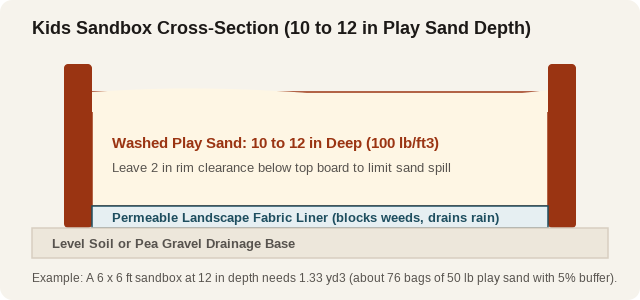
Most backyard sandboxes are built 8 to 12 inches deep so children can dig comfortably while leaving 2 inches of top board clearance to keep sand from spilling onto the lawn. Washed dry play sand weighs 100 lb/ft³ (1.35 US tons/yd³), meaning every cubic foot equals exactly two 50 lb bags.
Square and Rectangular Formula
Volume (ft³) = Length (ft) x Width (ft) x (Depth (in) / 12)
50 lb Bags = ceil((Volume (ft³) x 100 lb/ft³ x 1.05) / 50)
Every 1 inch of depth in a 6 x 6 ft sandbox adds 3 ft³ (300 lb), or 6 bags of 50 lb play sand.
Round and Octagonal Formula
Round Area = pi x (Diameter / 2)^2
Octagon Area = 2 x (sqrt(2) - 1) x (Flat Width)^2
An octagon measures roughly 82.8% of the area of a square with the same side-to-side width.
Standard Sandbox Size and Bag Chart (100 lb/ft³ Play Sand)
| Sandbox Size | Depth | Volume (+5% buffer) | Total Weight | 50 lb Bags Needed |
|---|---|---|---|---|
| 4 x 4 ft Toddler Box | 8 in | 11.2 ft³ (0.41 yd³) | 1,120 lb | 23 bags |
| 5 x 5 ft Compact Box | 10 in | 21.9 ft³ (0.81 yd³) | 2,188 lb | 44 bags |
| 6 x 6 ft Standard Box | 12 in | 37.8 ft³ (1.40 yd³) | 3,780 lb | 76 bags |
| 8 x 8 ft Large Box | 12 in | 67.2 ft³ (2.49 yd³) | 6,720 lb | 135 bags |
| 6 ft Round Sandbox | 10 in | 24.7 ft³ (0.92 yd³) | 2,474 lb | 50 bags |
Choosing Safe Play Sand and Lining
- Choose Washed, Low-Dust Play Sand: Look for bags labeled washed, screened, and free of free-crystalline silica dust. Avoid concrete sand or unwashed masonry sand, which contains sharp grit and fine dust.
- Line with Landscape Fabric, Not Plastic: Permeable weed-barrier fabric blocks grass roots and keeps sand clean while letting rainwater drain into the soil below. Solid plastic tarps trap standing water.
Sandbox Site Prep, Drainage, and Maintenance Checklist
A clean, dry sandbox depends as much on ground preparation and storage as on the sand itself. Review these practical steps before hauling bags home:
- Add a thin drainage base over heavy clay: Set the frame on flat, well-drained ground rather than a yard low spot. On slow-draining clay soil, spread a 2-inch layer of clean pea gravel underneath the landscape fabric so rain filters through instead of pooling at the bottom of the box.
- Staple fabric up the inside frame boards: Run permeable weed-barrier fabric across the base and 2 to 3 inches up the inner wood walls before stapling. That lip blocks topsoil, roots, and burrowing insects from entering along the bottom seam.
- Watch vehicle payload limits when buying bags: Forty 50 lb bags weigh 2,000 lb (1 US ton), which exceeds the safe cargo rating of most midsize SUVs and many half-ton trucks. Split large fills into two store trips or arrange pallet delivery for 6x6 and 8x8 builds.
- Fit a breathable cover rather than an airtight tarp: A mesh or breathable canvas cover keeps out leaves, rainwater debris, and neighborhood pets while letting damp sand dry out between play days.
- Plan an annual top-off: Kids carry sand out on shoes, buckets, and shovels throughout the summer. Keeping 4 to 6 extra 50 lb bags stored dry makes it easy to restore a 6x6 sandbox to full digging depth each spring.
- Seal lumber with child-safe finish: Build the frame from naturally rot-resistant cedar or redwood rather than chemically treated lumber, and round over top seat boards so kids have splinter-free edges to sit on while digging.
- Rake and air out after heavy rainstorms: Uncover the sandbox on sunny mornings after heavy downpours and rake the top few inches loose so sunlight dries damp pockets quickly and keeps the play sand soft and odor-free.
Standards and Technical References
- U.S. CPSC Public Playground Safety Handbook (Pub. 325) outlines depth, drainage, and maintenance practices for loose sand play areas.
- OSHA Crystalline Silica Safety Guidance explains why children's sandboxes require washed, low-dust play sand rather than unwashed construction or masonry sand.
- Engineering ToolBox Sand Density Reference and our methodology page document the 100 lb/ft³ (1,602 kg/m³) dry play sand benchmark.