How Polymeric Sand Coverage Is Calculated
Unlike bedding sand calculated by bulk cubic yards, polymeric joint sand is sold in 50 lb (22.7 kg) bags and depends on three paver geometry factors: joint width, paver thickness, and total linear joint length per square foot. Dense 4x8 brick pavers have far more joint lines per 100 sq ft than large 24x24 patio slabs, so brick patios consume more bags over the exact same square footage.
Joint Volume Formula
Joint Volume (ft³/sq ft) = Joint Width (in) x Pattern Factor x Fill Depth (in) / 12
50 lb Bags = ceil((Patio Area x Joint Volume / 0.50 ft³) x 1.10)
Each 50 lb bag of polymeric sand yields roughly 0.50 cubic feet of dry joint fill.
Industry Bag Coverage Benchmarks
Narrow Joints (1/8 to 1/4 in): 65 to 110 sq ft / 50 lb bag
Wide Joints (1/2 to 1 in): 22 to 45 sq ft / 50 lb bag
Always add 10% for sweeping loss and textured or tumbled paver chamfers.
Polymeric Sand Coverage Chart (per 50 lb Bag, 60 mm Pavers)
| Paver Format | 1/8 in Joint (3 mm) | 1/4 in Joint (6 mm) | 1/2 in Joint (13 mm) | 1 in Joint (Flagstone) |
|---|---|---|---|---|
| 4x8 Brick / Cobble | ~71 sq ft / bag | ~36 sq ft / bag | ~18 sq ft / bag | Not typical |
| Medium Pavers (12x12 to 12x18) | ~162 sq ft / bag | ~81 sq ft / bag | ~40 sq ft / bag | ~20 sq ft / bag |
| Large Format Slabs (24x24) | ~200+ sq ft / bag | ~157 sq ft / bag | ~78 sq ft / bag | ~39 sq ft / bag |
| Irregular Flagstone (1.5 in thick) | ~185 sq ft / bag | ~93 sq ft / bag | ~46 sq ft / bag | ~23 sq ft / bag |
4 Rules for Polymeric Sand Installation
- Dry Pavers Only: Both pavers and joints must be bone dry before sweeping, or the polymer binder will activate prematurely and leave haze on the stone.
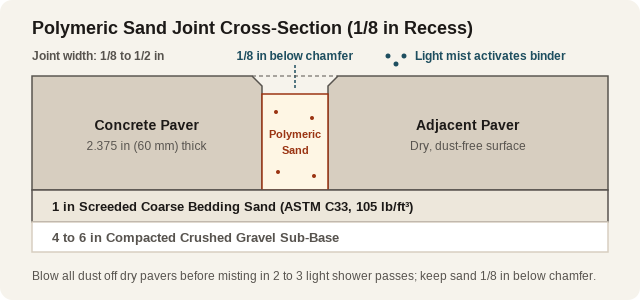
- Fill 1/8 inch Below the Top Edge: Sweep until sand sits just below the paver chamfer (about 1/8 inch down), then plate-compact once to settle voids and sweep again.
- Blow Off Every Trace of Dust: Use a leaf blower at a low angle to clear all fine dust from the paver surface before misting.
- Mist in Light Passes: Water gently in two or three light shower passes so water penetrates to the bottom of the joint without washing binder out of the top.
Avoiding Polymeric Sand Haze, Cracking, and Washout
Most polymeric sand failures come from moisture timing, surface dust, or mismatched joint widths rather than bad material. Keep these field safeguards in mind before opening a bag:
- Check the 24-hour forecast and temperature window: Wait for a dry 24-hour stretch with air and stone temperatures above 40 F (4 C). Rain on uncured binder washes milky polymer residue across textured pavers and leaves soft, sandy tops.
- Verify the joints are dry all the way down: After rain or pressure washing, wait at least one full sunny day before sweeping. Damp lower joints activate the top 1/4 inch prematurely, forming a brittle crust over hollow voids that crack within weeks.
- Size the formula to your widest gap: Measure the widest joint on the project rather than the average. Standard polymeric sand bridges narrow paver joints cleanly, while wide-joint blends use coarser angular aggregate rated for 1 to 2 inch flagstone gaps without shrinking.
- Activate with short misting passes, never a jet stream: Blast-hosing flushes polymer binder down into the bedding sand and strips the surface layer. Apply two or three light shower passes from a garden nozzle, stopping as soon as water beads briefly along the top of the joint.
Standards and Technical References
- Concrete Masonry & Hardscapes Association (CMHA, formerly ICPI) Tech Spec 2 and Tech Spec 6 cover interlocking paver joint fill depth, dry-sweeping, plate compaction, and polymeric stabilization practices.
- ASTM C144: Standard Specification for Aggregate for Masonry Mortar provides the fine joint-sand gradation baseline used in segmental pavement joints.
- NIST Unit Conversion Factors and our formula verification page govern the 0.50 ft³ per 50 lb bag imperial and metric conversions.