Pool Base Sand and Wall Cove Formulas
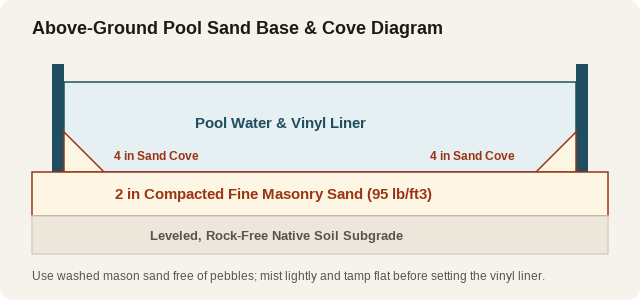
Installing an above-ground vinyl pool requires a smooth 2 inch (5 cm) cushion of washed fine masonry sand (95 lb/ft³), plus an optional 4 in x 4 in triangular sand cove along the inside perimeter wall so water pressure never forces the liner under the metal track.
Round Pool Sand Formula
Floor Area (sq ft) = pi x (Diameter / 2)^2
Cove Volume (ft³) = pi x Diameter x (0.333 x 0.333 / 2)
An 18 ft round pool has 254.5 sq ft of floor area (42.4 ft³ at 2 in) plus ~3.14 ft³ for a 4-inch perimeter wall cove.
Oval Pool Sand Formula
Floor Area = Width x (Length - Width) + pi x (Width / 2)^2
US Tons = ((Base ft³ + Cove ft³) x 1.10 x 95) / 2000
Stadium oval geometry matches standard steel-wall above-ground pool shapes accurately.
Above-Ground Pool Sand Reference Chart (2 in Base + 4 in Cove + 10% Buffer)
| Pool Size | Floor Area | Volume Needed | Masonry Sand (95 lb/ft³) | 50 lb Bags Equivalent |
|---|---|---|---|---|
| 12 ft Round | 113.1 sq ft | 0.85 yd³ | 1.09 US tons (2,179 lb) | 44 bags |
| 15 ft Round | 176.7 sq ft | 1.31 yd³ | 1.68 US tons (3,351 lb) | 68 bags |
| 18 ft Round | 254.5 sq ft | 1.85 yd³ | 2.38 US tons (4,752 lb) | 96 bags |
| 24 ft Round | 452.4 sq ft | 3.24 yd³ | 4.16 US tons (8,311 lb) | 167 bags (order bulk) |
| 15 x 30 ft Oval | 401.7 sq ft | 2.89 yd³ | 3.70 US tons (7,406 lb) | 149 bags (order bulk) |
| 18 x 33 ft Oval | 524.4 sq ft | 3.74 yd³ | 4.80 US tons (9,605 lb) | 193 bags (order bulk) |
Best Sand for Above-Ground Pools
Always ask your supplier for washed fine masonry sand (also called mason sand or plaster sand) with zero pebbles. Avoid coarse concrete sand or unscreened fill sand, because small stones work to the surface over time and can puncture vinyl pool liners under thousands of gallons of water weight.
Above-Ground Pool Pad Inspection and Liner Safety Checklist
Because thousands of gallons of water press down evenly across the vinyl floor, small base flaws show up immediately after filling. Run through these checks before setting the liner:
- Level the native earth first, not with extra sand: Dig down high areas with a shovel and transit or straight board until the native soil circle is level within 1/2 inch across the diameter. Sand cushions the liner; it cannot hold grade on a sloped yard.
- Rake and hand-inspect for hidden pebbles: Even washed masonry sand can pick up stray gravel from a dump truck bed. Spread the 2-inch pad in thin lifts, pull out any stones, roots, or hard clay clods, and lightly dampen the surface before packing with a hand tamper or water-filled lawn roller.
- Form a tight, uniform 4-inch perimeter cove: Pack damp masonry sand along the inside base of the steel wall into a smooth 45-degree wedge so water pressure never pushes the liner underneath the bottom track. Pre-formed peel-and-stick foam coves are a fast alternative that save 3 to 5 ft³ of sand and resist washout.
- Pad bottom track connector plates: Cover metal rail joints with heavy duct tape and smooth extra compacted sand over the seam so sharp edges cannot abrade the liner floor.
- Trowel out footprints backward barefoot: Walk barefoot while sweeping final heel prints smooth toward your exit point before draping the vinyl liner so the pool floor cures flat and comfortable underfoot.
Standards and Technical References
- ASTM C144: Standard Specification for Aggregate for Masonry Mortar defines washed fine masonry sand gradation without coarse pebbles that can puncture vinyl liners.
- Engineering ToolBox Sand Density Reference supports the 95 lb/ft³ (1,522 kg/m³) fine dry masonry sand weight benchmark.
- NIST SI and US Customary Unit Conversions and our full methodology page govern cubic yard, US ton, and metric conversions.