How Much Sand Do You Need for an Aquarium?
Freshwater planted aquariums and marine reef tanks typically use 1 to 2 inches of sand substrate (95 to 105 lb/ft³ dry density), while bare-bottom alternatives or African cichlid displays often use 0.5 to 1 inch for easy siphon cleaning.
Imperial Tank Formula (Inches)
Volume (cu in) = Length (in) x Width (in) x Depth (in)
Weight (lb) = (Volume (cu in) / 1728) x Density (lb/ft³)
One cubic foot equals 1,728 cubic inches and holds roughly 95 to 105 lb of aquarium sand.
Metric Tank Formula (cm)
Volume (L) = (Length (cm) x Width (cm) x Depth (cm)) / 1000
Weight (kg) = (Volume (L) / 1000) x Density (kg/m³)
Every 1 liter of dry silica or aragonite aquarium sand weighs roughly 1.52 to 1.60 kg.
Standard Aquarium Sand Weight Chart (at 2 inch Bed Depth)
| Standard US Tank | Footprint (L x W) | Sand Weight (2 in depth, 95 lb/ft³) | Recommended 20 lb Bags | Water Displaced |
|---|---|---|---|---|
| 10 Gallon Standard | 20 x 10 in | 22.0 lb (10.0 kg) | 2 bags (or 1 x 20 lb + 1 x 5 lb) | 1.7 gal |
| 20 Gallon Long | 30 x 12 in | 39.6 lb (18.0 kg) | 2 bags | 3.1 gal |
| 29 Gallon Standard | 30 x 12 in | 39.6 lb (18.0 kg) | 2 bags | 3.1 gal |
| 40 Gallon Breeder | 36 x 18 in | 71.3 lb (32.3 kg) | 4 bags | 5.6 gal |
| 55 Gallon Standard | 48 x 13 in | 68.6 lb (31.1 kg) | 4 bags | 5.4 gal |
| 75 Gallon Standard | 48 x 18 in | 95.0 lb (43.1 kg) | 5 bags | 7.5 gal |
| 125 Gallon Standard | 72 x 18 in | 142.5 lb (64.6 kg) | 8 bags (or 3 x 50 lb filter sand) | 11.2 gal |
Choosing Safe Aquarium Sand
- Freshwater Tanks: Inert #20 silica pool filter sand or washed quartz sand keeps pH neutral and avoids sharp edges for bottom-dwelling corydoras and loaches.
- Saltwater Reef Tanks: Use calcium-carbonate aragonite sand (
100 lb/ft³) to help buffer marine alkalinity and pH naturally. Never use bagged hardware-store play sand in reef aquariums because high silicate levels trigger stubborn diatom blooms.
Rinsing Aquarium Sand and Preventing Cloudiness
Fine sand turns tank water milky fast if added straight from a dry bag, and airborne silt can wear down filter motors. Use this setup sequence for a clear fill:
- Rinse dry sand in small bucket batches: Pour dry silica, quartz, or dry aragonite sand into a clean 5-gallon bucket no more than one-third full. Push a garden hose to the bottom, stir steadily by hand, and let cloudy runoff spill over the rim until the water looks clear. Skip rinsing bagged marine live sand so you do not wash away live nitrifying bacteria.
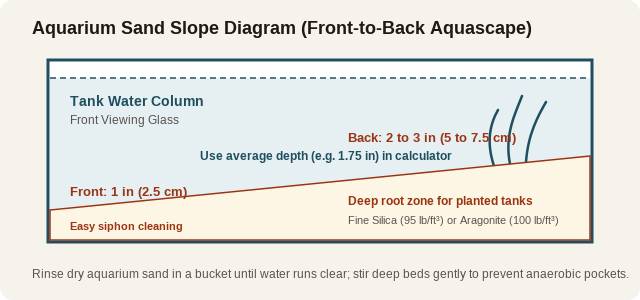
- Slope from front to back for visual depth: Keep the substrate around 1 inch deep along the front glass so debris stays visible and easy to siphon, then bank it up to 2.5 or 3 inches toward the back wall for rooted plants. Enter your average depth (such as 1.75 in) in the calculator above when estimating a sloped aquascape.
- Pour water over a saucer or clean plastic bag: Place a small ceramic plate on top of the sand bed and direct incoming dechlorinated water onto the dish so the stream diffuses gently without digging craters.
- Wait to start filters until silt settles: Keep hang-on-back and canister filters off for 30 to 60 minutes after filling so suspended sand grains settle instead of grinding against magnetic impeller shafts.
- Keep deeper zones oxygenated: If any section exceeds 2 inches deep, poke it gently with a chopstick during water changes or keep burrowing snails to stop stagnant anaerobic pockets from forming.
Standards and Technical References
- Engineering ToolBox Bulk Sand Densities supports the 95 to 105 lb/ft³ (1,522 to 1,682 kg/m³) dry silica and aragonite substrate density range.
- NIST Unit Conversion Factors defines the exact 1,728 cubic inches per ft³, 231 cubic inches per US gallon (for water displacement), and pound-to-kilogram factors used in our verified formulas.