Paver Bedding Sand Volume and Weight Formulas
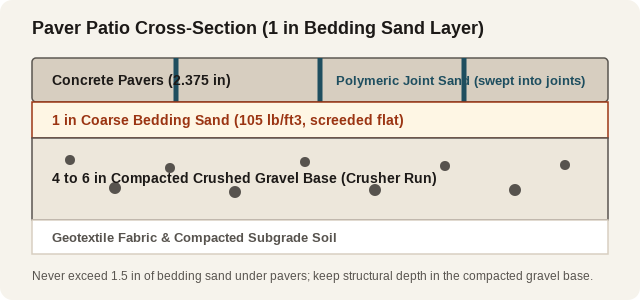
Paver installers separate structural support from leveling: a 4 to 6 inch compacted crushed gravel sub-base carries the load, while a 1 inch screeded layer of coarse concrete sand (ASTM C33) cushions and locks the pavers into level grade.
Imperial Paver Sand Formula
Volume (ft³) = Length (ft) x Width (ft) x (Depth (in) / 12)
Cubic Yards (yd³) = (Volume (ft³) / 27) x 1.10
US Tons = (Volume (ft³) x 1.10 x 10⁵) / 2000
At 1 inch thick, 1 cubic yard of coarse bedding sand covers 324 sq ft net (or roughly 295 sq ft with a 10% buffer).
Metric Paver Sand Formula
Volume (m³) = Length (m) x Width (m) x (Depth (cm) / 100)
Weight (kg) = Volume (m³) x 1682 kg/m³ x 1.10
Standard European and metric patio bedding depth is 2.5 cm (25 mm) of washed sharp concrete sand.
Paver Sand Coverage Reference Table (at 1 inch Depth)
| Patio Size | Area | Sand Volume (+10%) | Coarse Sand Weight | 50 lb Bags |
|---|---|---|---|---|
| 10 x 10 ft Patio | 100 sq ft | 0.34 yd³ | 0.48 US tons (963 lb) | 20 bags |
| 10 x 12 ft Patio | 120 sq ft | 0.41 yd³ | 0.58 US tons (1,155 lb) | 24 bags |
| 12 x 16 ft Patio | 192 sq ft | 0.65 yd³ | 0.92 US tons (1,848 lb) | 37 bags |
| 16 x 20 ft Patio | 320 sq ft | 1.09 yd³ | 1.54 US tons (3,080 lb) | 62 bags |
| 12 x 40 ft Driveway | 480 sq ft | 1.63 yd³ | 2.31 US tons (4,620 lb) | 93 bags |
Screeding Checklist and Common Paver Sand Mistakes
Getting the bedding layer right prevents wavy pavers and sunken tire tracks after the first wet season. Follow these field checks before placing stone:
- Screed over rigid 1-inch rails: Lay two parallel lengths of 1-inch outer-diameter metal conduit across the compacted gravel base, pull a straight 2x4 board smoothly across the rails, then lift the pipes out and hand-trowel the shallow channels flat. Never step on freshly screeded sand.
- Leave bedding sand loose before laying pavers: Place pavers directly onto the uncompacted 1-inch bed. When you run a plate compactor over the finished paver surface afterward, the pavers settle roughly 1/4 inch into the sand and push coarse grains slightly up into the lower joints to lock the pattern.
- Correct gravel low spots with stone, not extra sand: Pockets deeper than 1.5 inches compact unevenly under patio furniture or wheel loads and trap standing water. Re-grade any low spots in the crushed stone base before spreading bedding sand.
- Protect bulk piles from heavy rain: Slightly damp coarse sand screeds cleanly and holds its plane, while rain-soaked sand bulks unpredictably and slumps under the screed board. Cover your stockpile with a weighted tarp overnight.
- Anchor edge restraints tightly into the gravel base: Spike plastic, aluminum, or concrete border edging down before final plate compaction so outer pavers cannot shift outward and open bedding gaps along the patio perimeter.
- Keep consistent slope away from structures: Match the gravel base grade at 1/8 to 1/4 inch of drop per foot away from house foundations before laying screed rails. Screeding a uniform 1-inch sand thickness preserves that drainage pitch without creating thin high spots.
- Order bulk delivery above 1 cubic yard: Once a patio passes roughly 300 sq ft, 60 or more 50 lb bags cost far more and add unnecessary handling compared to a single bulk yard dumped onto a driveway tarp.
Standards and Technical References
- ASTM C33 / C33M: Standard Specification for Concrete Aggregates defines washed coarse concrete sand gradation for paver bedding layers.
- Concrete Masonry & Hardscapes Association (CMHA, formerly ICPI) Tech Spec 2 and Tech Spec 17 specify a nominal 1-inch (25 mm) coarse bedding sand layer over a compacted crushed stone base.
- FHWA Aggregate Density Guidelines and our full verification methodology document the 105 lb/ft³ (1,682 kg/m³) coarse sand benchmark.
Complete Your Hardscape Build
Need to estimate the 4 to 6 inch crushed stone sub-base under your bedding sand, pour a concrete border slab, or calculate the sand swept between paver joints? Use our companion estimators:
- For sweeping joint stabilizer after pavers are laid and plate-compacted, open the Polymeric Sand Calculator.
- For estimating the 4 to 6 inch compacted crusher run base layer, use our Gravel Calculator or Concrete Calculator for concrete edge curbs.